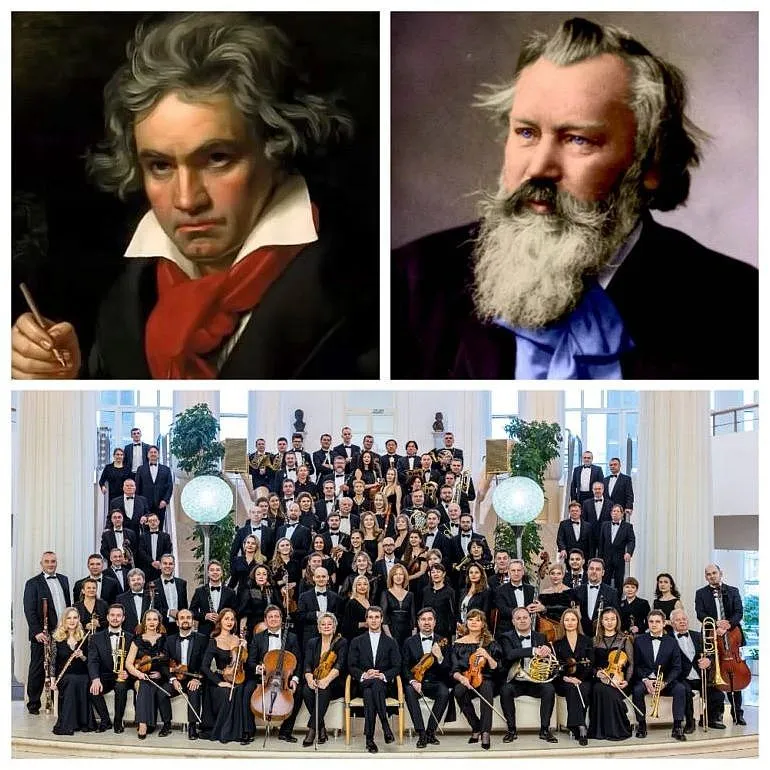
The coming program by the NPR and Arsenty Tkachenko at the Moscow House of Music will present great works by German classics Ludwig van Beethoven and Johannes Brahms. The concert will also feature soprano Elizaveta Kulaghina, soloist of the Helicon Opera House, winner of the Galina Vishnevskaya Opera Artists Contest and awardee of the Hibla Gerzmava Competition, baritone Alexander Sukhanov, prizewinner of international and All-Russia contests, and the Masters of Choral Singing Choir.
’The names of these two great composers in one concert is not fortuitous, especially remembering that Brahms’s First Symphony is called Beethoven’s Tenth Symphony, says Arsenty Tkachenko. Both geniuses belonged to the same composition school; both were born in Germany and got famous in Vienna. Brahms considered himself Beethoven’s successor, but the main thing uniting them is their creative spirit.
Everyone knows that Beethoven’s Fifth Symphony starts with the Fate motive and is leading from darkness to light, through battle to victory. Amazing, as it may seem but Brahms’s Requiem is also aspiring to lightness. It is not a lamenting opus and its author relinquished the traditional Latin text and the traditional structure of a funeral mass. Brahms wrote that he would easily omit the word «German» and put in the word «man» instead. For me personally Brahms’s Requiem is a luminous music, which makes us think about living people rather than a mass mourning the dead. Thus the whole program is the music searching answers to eternal questions of human being, struggle and life itself.’
Beethoven’s C minor Symphony was first performed on December 22, 1808, in the Imperial Theater an-der-Wien conducted by the author himself. Musicologists see it as the voice of ideas of the French Revolution (its Finale calls for reminiscences of Marseillaise) and the symbol of dramatic symphonism for Beethoven’s followers. However, it is worth noting that Beethoven, offering his new composition to editors, brought their attention not to its dramatics (from darkness to light), images, thematic or innovations in the music language, For him it was more important to underline the introduction of three trombones (capable of making a great noise), a piccolo flute and a contra-bassoon. This fact shows that if Beethoven had intentions to revolutionize music it was first of all in orchestration: the creation of an independent and equal group in the orchestra, that is the brass section, made an impact on the further development of symphony music.
Innovational was also A German Requiem by Brahms in which the composer paid tribute to the memory of the people dear to him — his mother and Robert Schumann (his spiritual father, idol and teacher). In particular, he brought to life Schumann’s idea of writing a monumental epic oeuvre connected to the history and life of German people, understandable to a citizen and a peasant, suitable for church and concert halls. The author composed the text using the Holy Scripture in Martin Luther’s translation highlighting consolation and recompense for life labors. Missing descriptions of the Doomsday terrible punishments and edification, A German Requiem is like a lyrical and poetic preaching, an ode to immortality. Its main message is that ’their works do follow them’ sung in the Finale and glorifying the creative impulse as the principle life force.