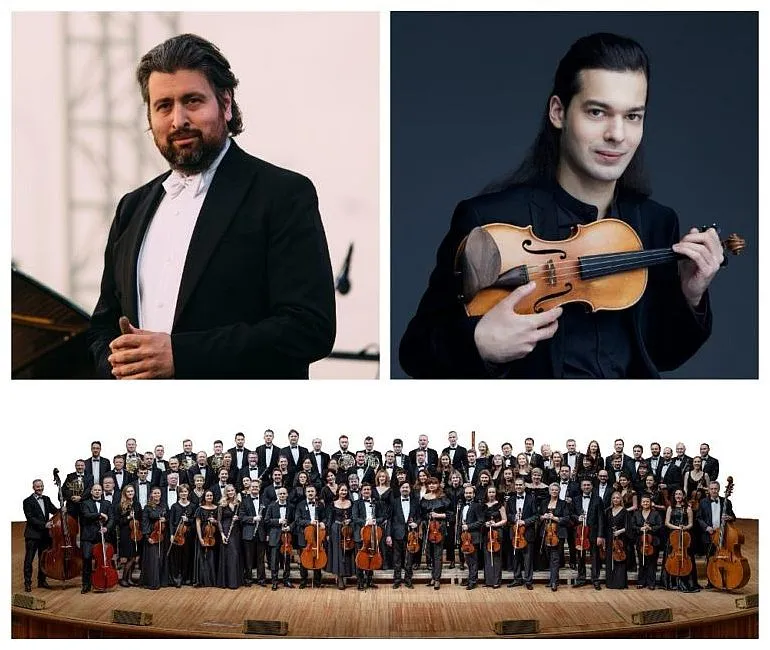
On November 25, the National Philharmonic Orchestra of Russia will play under the baton of Dmitri Jurowski, the youngest representative of the famous conductor dynasty, one of the most experienced, masterful and sought-after orchestra directors of his generation. Earlier he worked with Vladimir Spivakov’s orchestra only once, leading the NPR in Dinara Alieva’s opera gala in 2010. He says that he liked to work then with the orchestra for he had known many orchestra members since his childhood. After fifteen years, he returns on the NPR’s podium with a symphonic program.
Critic Igor Koriabin calls Dmitry Jurowski:
’a great distinctive artist of music, master of orchestra direction whose gestures are smoothly elegant, devoid of affectation but poignantly profound՛ and relay to the musicians ’rare soulfulness and warmth, and charge them with inner energy full of great intellectual power’ and entice them while making the audience sense the grandiosity of sanctification.
The concert program combines seldom performed works written during historical turning points and transmitting the stresses of the epochs. The pieces of a Finnish, Italian and Czech classics refer to important moments also in the personal lives of their authors. The night will open with Jean Sibelius’s Finlandia tone poem which embodies the composer’s and his contemporaries’ protest against the Russian Tsarist autocracy’s oppression of Finnish democracy. Sibelius’s coevals stated that Finlandia helped Finns to succeed in their fight for liberty much more than numerous talks and pamphlets. The rather small symphonic score is marked by an epic scope, folklore themes (without citing existing songs) and opulent orchestration.
The author of the famous Roman Triptych, Ottorino Respighi like Sibelius in his younger years was preparing for a violinist career and played the violin in an orchestra. His teachers included, among others, Max Bruch. In 1921, Respighi wrote Concerto Gregoriano in which the outer virtuosity concedes to a deep lyricism, which is preconditioned by an uncommon historical angle of the work. The composer, enchanted by ancient musical texts, brought into the score genuine Gregorian melodies. It resulted in an amazing combination of the archaic and the modern in the opus in which the violin keeps a dialogue with the past.
The solo part that demands technical excellence together with spiritual concentration will be played by violinist Leonid Zhelezny, graduate from the Moscow Conservatory, awardee of international contests such as the Beethoven Competition in Austria, the Leopold Auer Competition in Saint-Petersburg, the Vladimir Spivakov Competition in Ufa, the Vaclav Huml Competition in Croatia, and contests in Harbin and Stockholm. The musician debuted with the NPR in the previous season and the coming concert promises a successful future collaboration.
The program will end with Antonín Dvořák’s Seventh Symphony written in 1884 on commission from the London Philharmonic Society. It is one of the most dramatic and dark works by the composer, his artistic response to the events connected with the struggle of the Czech people for their national liberation as well as with the composer’s personal tragedies including his mother’s death.
While composing the Symphony Dvořák wrote:
’Today I have finished the Second Movement of my new symphony and during the work I felt myself happy and joyful... for my motto is and will be "God, Love and Homeland!’