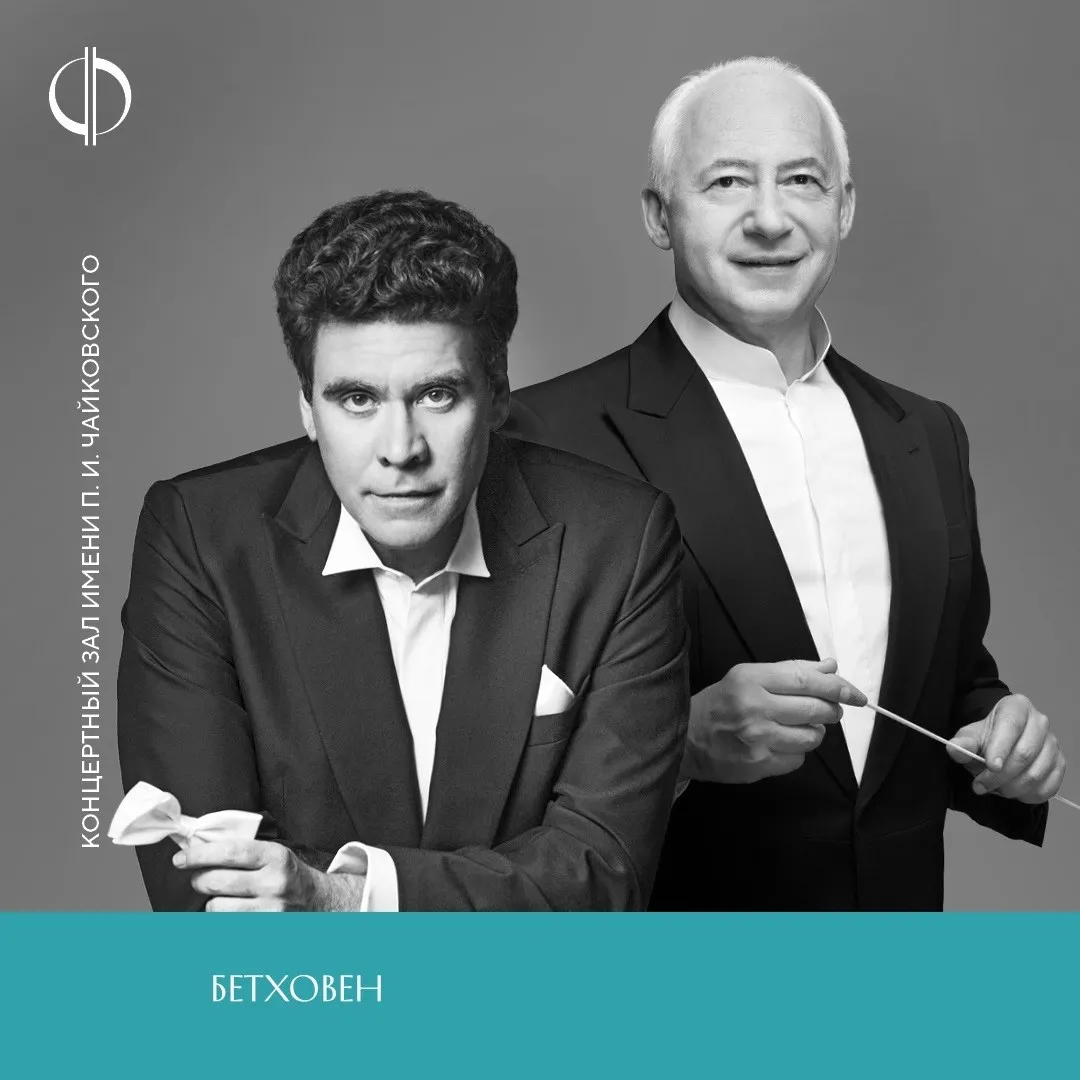
February 21, 2026 | Tchaikovsky Concert Hall
Soloist – Denis Matsuev, piano
Conductor – Vladimir Spivakov
Beethoven. Symphony No. 7 in A major, Op. 92
Beethoven. Concerto No. 3 for piano and orchestra in C minor, Op. 37
Ludwig van Beethoven's oeuvre is an important part of the repertoire of the National Philharmonic Orchestra of Russia and Vladimir Spivakov who dedicated to the composer a subscription series some years back. The coming night's program combines the Seventh Symphony, one of the most extraordinary compositions by Beethoven who considered it to be his best one (several years later Tchaikovsky shared the view) and Piano Concerto No. 3 – symphonic drama.
The vital Seventh Symphony was composed in 1811-1812 when Europe was languishing for the victory over Napoleon, while Beethoven got reconciled with his imminent deafness and lost his dreams of his own happiness but was quite acceptive of the events going in Europe. The score of the Symphony becoming the music harbinger of the triumph, a great provision, was completed on April 13, 1812, and premiered on December 6, 1813, under the composer's baton in Vienna. In its many traits, especially in its rhythmic peculiarity, musicologists find the foretokens of the music by Stravinsky and Bartók. It is not by chance that Wagner claimed the Seventh Symphony to be an 'apotheosis of the dance itself'. In the amazing amalgam of the Symphony's thematic picture of various folk tunes, such as Slavic in Allegretto, Austrian in Scherzo, Romany-Hungarian in the Finale, and so on, one can see the symbol of the unity of nations on their way to the general victory (to which later on will bring the Finale of the Ninth Symphony with its “Seid umschlungen, Millionen!”).
The Third Piano Concerto, dedicated to the Prussian Prince Louis Ferdinand (a patron of the arts, a gifted pianist, and composer), is Beethoven's first major symphonic work in a minor key, which became a full-fledged drama. An abstract soloist-orchestra rivalry is depicted here as a confrontation between the hero's personality and fate. The Third Concerto in many ways anticipated the subsequent development of its genre in the Romantic era: the pathetic Allegro is followed by a contemplative slow movement, one of Beethoven's most beautiful lyrical pages, followed by a playful Hungarian-style contredanse.
The soloist in the Third Concerto will be Denis Matsuev, People's Artist of Russia, constant artistic partner of Vladimir Spivakov and the NPR, whose favorite trio of composers include Beethoven, Rachmaninoff and Prokofiev. The musician's name is connected with many auspicious events and projects in Russia's cultural life; the artist has been decorated with many esteemed State awards and is heading the Public Council at the Ministry of Culture, also directing several festivals and foundations.