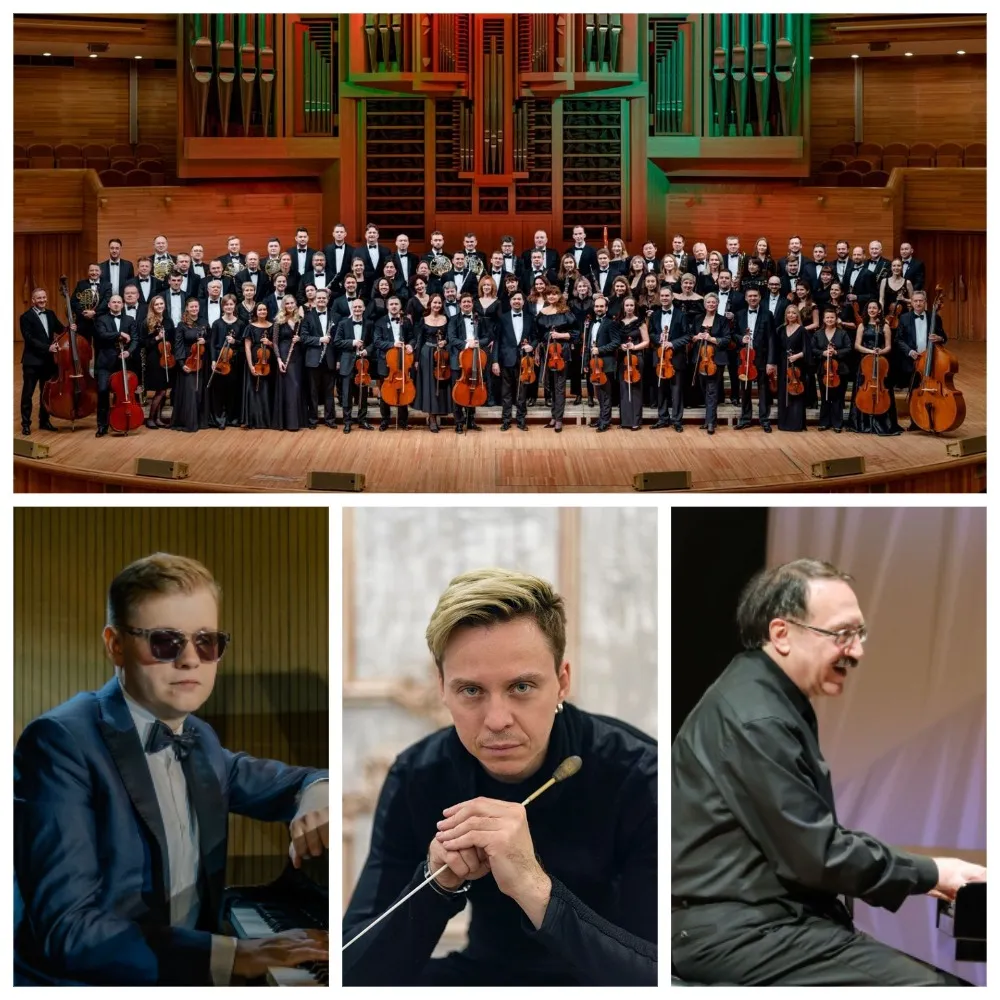
October 8, 2026 | Zaryadye Concert Hall
Soloists: Oleg Akkuratov*, Daniil Kramer**, piano
Conductor – Alexey Vereshchagin
Rachmaninoff. Rhapsody on a Theme of Paganini for piano* and orchestra, Op. 43
Gershwin. Rhapsody in Blue for piano** and orchestra
Mozart. Divertimento No. 3 in F major, KV 138
Mozart. Concerto No. 10 for two pianos and orchestra in E-flat major, KV 365 (316a)
On October 8 the National Philharmonic Orchestra of Russia will appear in the Zaryadye Concert Hall with a program which combines Mozart’s early pieces with outstanding symphonic masterworks of the 20th century. The orchestra will be joined by pianists Daniil Kramer and Oleg Akkuratov, both well known in academic and jazz circles, and The Bolshoi’s conductor Alexey Vereshchagin, once a participant of the NPR’s training group and successfully co-working with the orchestra now. Alexey Vereshchagin has already presented symphonic programs, also with the participation of Daniil Kramer and Oleg Akkuratov. This time Kramer will be the soloist in Gershwin’s Rhapsody in Blue and Akkuratov — in Rachmaninoff’s Rhapsody on a Theme of Paganini, and then they both will play Mozart’s Concerto for two Pianos.
Jazz plays an important role in the artistic life of Daniil Kramer and Oleg Akkuratov, while for the latter it is also part of his professional education. Both musicians often unite two worlds — classic and jazz — in their programs, and Daniil Kramer builds whole concert cycles at the intersection of academic and jazz traditions, also addressing crossover and the so called «third stream».
Two Rhapsodies for piano and orchestra — by Gershwin and Rachmaninoff — have many connections: Rachmaninoff attended the first performance of Rhapsody in Blue at the Aeolian Hall in New York City and witnessed the triumph of Gershwin who was the first in history to « lead the Lady Jazz as an important guest into musical high society» as Walter Damrosch put it. Ten years later and armed with Gershwin’s idea of symphonic variations, Rachmaninoff built his Rhapsody on the well-known Caprice 24 by Paganini for violin solo. He turned the virtuoso theme into a dramatic tale where the familiar material is constantly changing its character while the most famous variation is the one that has evident traits of earlier jazz.
The Mozartean part of the concert provides the historical background. Divertimento KV 138 belongs to the Salzburg period, written in the composer’s youth. Bravura Concerto no 10 for two pianos and orchestra is related to Mozart’s home music-making with his sister Nannerl and belongs to his most large-scale works for keyboard instruments. The Concerto is characterized by artful interaction of the soloists and exquisite orchestration. Daniil Kramer and Oleg Akkuratov will demonstrate in this non-ordinary program three different approaches to virtuosity: i.e. Mozart’s brightness, Rachmaninoff’s romantic expressiveness and Gershwin’s jazz freedom.