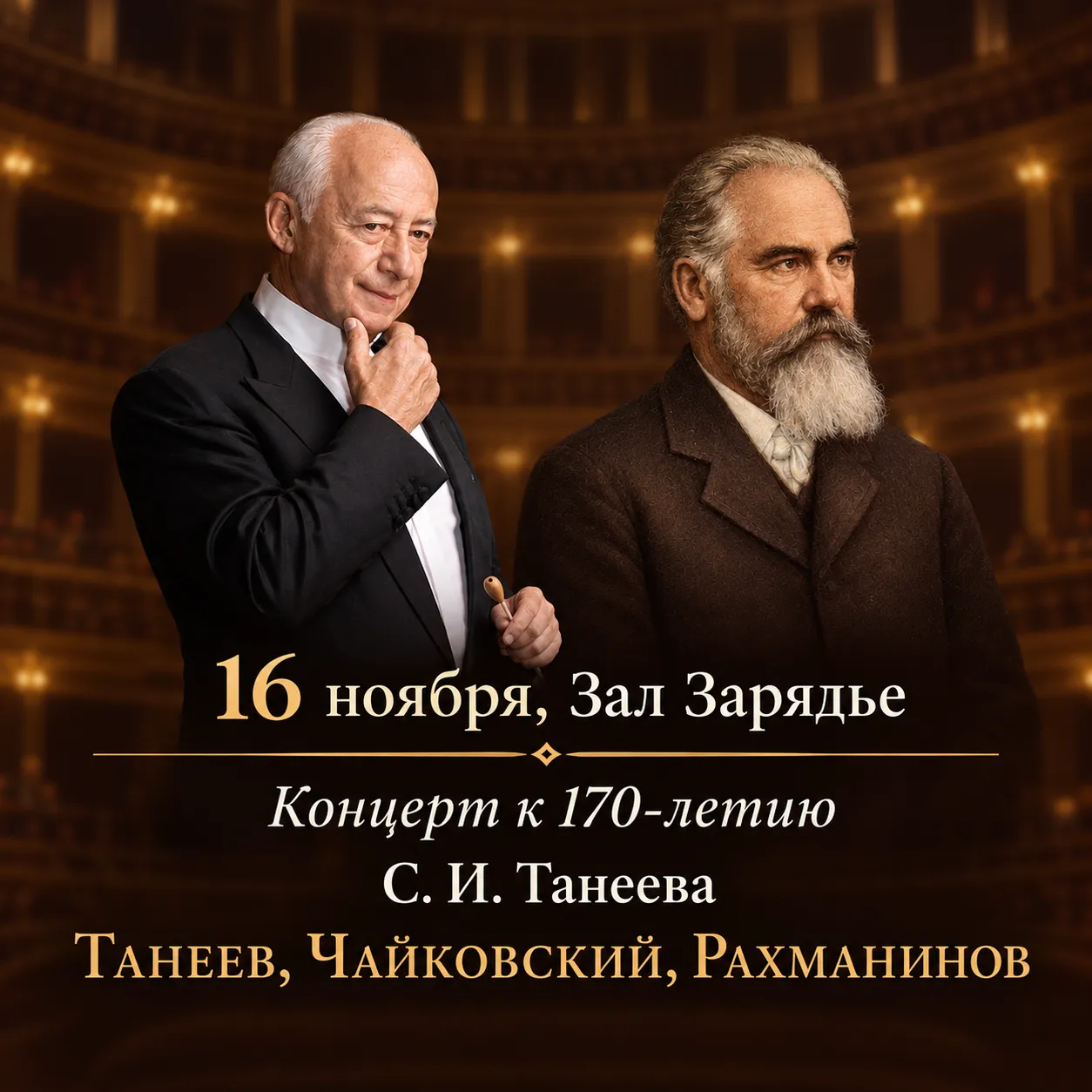
November 16, 2026 | Zaryadye Concert Hall
Soloist – Stefania Pospekhina, violin
Academic Grand Choir “Masters of Choral Singing” of the Orpheus Radio-TV Centre
Conductor – Vladimir Spivakov
Tchaikovsky. Concerto fo violin and orchestra in D major, Op. 35
Taneyev. John of Damascus, cantata on verses by A. K. Tolstoy, Op. 1
Rachmaninoff. Three Russian Songs for choir and orchestra, Op. 41
The forthcoming concert by Vladimir Spivakov and the National Philharmonic Orchestra of Russia is dedicated to the 170th anniversary of the birth of the outstanding Russian classical composer Sergei Ivanovich Taneyev (1856–1915). Taneyev’s music will be heard alongside works by his teacher Pyotr Ilyich Tchaikovsky and his pupil Sergei Rachmaninoff.
“A master composer, the most learned musician of his time, a man of rare individuality, originality and spiritual qualities, the pinnacle of Moscow’s musical life... A model in everything, in every one of his undertakings, for whatever he did, he did well” – this is how Rachmaninoff described Taneyev. Tchaikovsky held Taneyev’s personal qualities and creative work in equally high regard, particularly cherishing his cantata John of Damascus. He described his younger colleague and friend as “an outstanding musical personality” and “a man of extraordinary moral purity and great integrity”, distinguished by “great talent, considerable intellect, and an ocean of hatred for everything conventional, vulgar, and cheaply attained.”
Taneyev was not only a brilliant pianist and outstanding composer, but also a pre-eminent scholar of counterpoint, whose work revolutionised Russian musicology and influenced European scholarship. A polyglot and erudite, he was the first gold medallist of the Moscow Conservatory and an enthusiastic auditor at Moscow University. His friends included Turgenev, Tolstoy, Timiryazev, Stoletov and many other prominent figures in the arts and sciences. A highly respected teacher and professor, he also served for a time as director of the Moscow Conservatory. Without relying on formalised teaching methods, he nurtured an entire generation of musicians across different disciplines and helped launch their artistic careers. Prokofiev, for instance, acknowledged that it was Taneyev who had “spurred him on to serious musical study.” Taneyev was also one of the founders and most active advocates of the People's Conservatory, which undertook to provide anyone interested with a general musical education.
Taneyev’s celebrated cantata John of Damascus is set to a poem by Alexei Tolstoy, devoted to the life of the legendary Christian saint – one of the Eastern Orthodox Church Fathers of the 7th–8th centuries, a renowned theologian and author of sacred hymns (c. 675–c. 753). A particularly important role in the work is played by the theme of the Orthodox funeral chant “With the Saints Give Rest” from the 1772 Obikhod of Church Singing – an ancient, austere melody from the Orthodox burial rite, closely related to the theme of the medieval Catholic sequence Dies irae. The cantata is dedicated to the memory of Nikolai Rubinstein, Taneyev’s teacher and the founder and first director of the Moscow Conservatory.
Vladimir Spivakov calls John of Damascus “a unique Russian Requiem” and “a prophetic musical masterpiece”, placing it among the great scores “that tell us more about Russia than anything else.” In 2015–2016, the maestro recorded Taneyev’s cantata with the Masters of Choral Singing and the National Philharmonic Orchestra of Russia. The recording was released as part of the album Holy Rus. It was subsequently made available on all major streaming platforms.
The first half of the concert will feature Tchaikovsky’s Violin Concerto, dedicated to Adolph Brodsky. The programme will conclude with Rachmaninoff’s Three Russian Songs, a work described by musicologist Vera Briantseva as “a little tragic symphonietta on Russian themes.” In this dramatic triptych, the composer drew on authentic melodies from three folk songs: “Across the River, Across the Swift-Flowing Stream,” “Oh, You, Vanka, You Dashing Fellow,” and “My Fair and Rosy-Cheeked Maidens.”