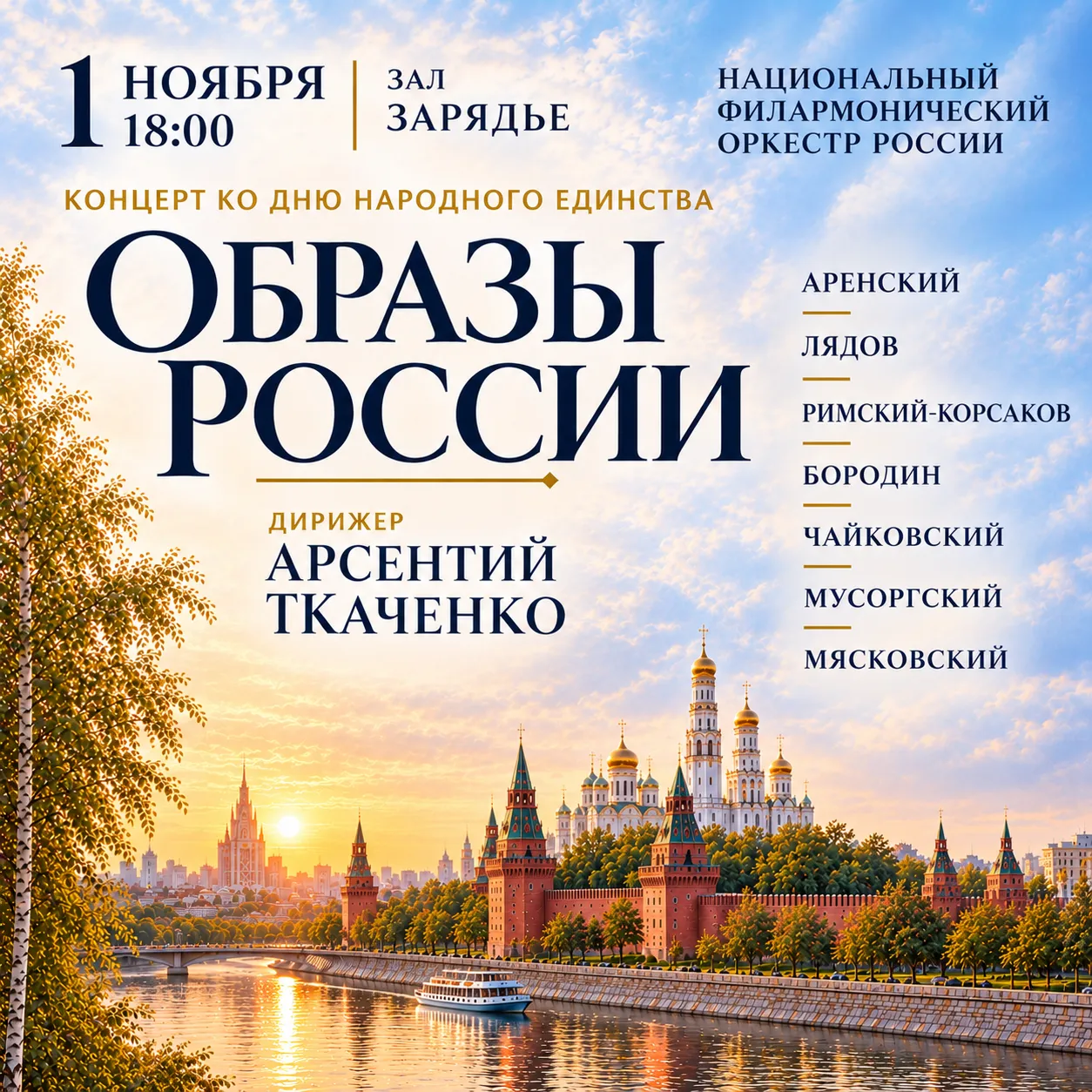
November 1, 2026, 18:00 | Zaryadye Concert Hall
Conductor – Arsenty Tkachenko
Presenter – Artem Wahrgaftig
Mussorgsky. Introduction to the opera Khovanshchina (“Dawn on the Moskva River”)
Rimsky-Korsakov. “The Battle of Kerzhenets” from the opera The Legend of the Invisible City of Kitezh and the Maiden Fevroniya
Borodin. “Polovtsian Dances” from the opera Prince Igor
Lyadov. Polonaise for Orchestra in C major, “In Memory of A. S. Pushkin,” Op. 49
Tchaikovsky. Symphony No. 4 in F minor, Op. 36: IV. Finale
Arensky. March for Orchestra in C major, “In Memory of Suvorov,” Op. posth.
Arensky. Introduction to the cantata "The Fountain of Bakhchisarai"
Myaskovsky. Symphony No. 27 in C minor, Op. 85: II. Adagio
Tchaikovsky. Solemn Overture “1812,” Op. 49
The concert of the National Philharmonic Orchestra of Russia on November 1st at the Zaryadye Concert Hall is set to celebrate the National Unity Day. Conductor Arsenty Tkachenko has gathered works written within 150 years and referred to the history, literature and cultural memory of Russia.
The introduction to Mussorgsky’s opera Khovanshchina — The Dawn on the Moscow River takes the audience to the 17th century, the epoch of political and religious upheavals, struggles for power and clashes of different ideas of the future of Russia. It is worth noting that instead of a dramatic prologue the composer created an inspired beautiful orchestral painting of an awakening Moscow.
Historic memory became the theme of works by Arensky and Lyadov: Arensky’s March was dedicated to Alexander Suvorov, one of the most famous Russian military commanders, whereas Lyadov’s Polonaise — to Alexander Pushkin whose oeuvre has influenced in many ways the progress of Russian literature and the nowadays Russian language.
Rimsky-Korsakov revoked older Russian tales in his opera The Legend of the Invisible City of Kitezh and the Maiden Fevroniya. The opus is based on the legend about a city that had been miraculously saved from the army of Batu Khan. The story here turns into a myth of belief, spiritual strength and the fate of Russia.
Another old-Russian theme was used by Borodin in his opera Prince Igor on the themes of The Tale of Igor’s Campaign. The composer had been writing the opera for over two decades and still not finishing it. After his death the opera was prepared for the stage by Rimsky-Korsakov and Glazunov. Using the monument of Russian literature Borodin created one of the greatest examples of Russian musical epics.
Myaskovsky’s 27th Symphony, completed in 1949, is his last composition. It was written after the Anti-Formalism campaign in the Soviet music in 1948, that also had affected his activity, and is a kind of summation of his lifelong work in the main instrumental genre, continuing the line from Tchaikovsky and uniting the classical traditions with the music of the 20th century.
The historic memory takes on another scale in Tchaikovsky’s The Year 1812 Solemn Overture dedicated to the victory over Napoleon and written on the eve of the completion of the Cathedral of Christ the Saviour in Moscow. The Overture is built on the intonational juxtaposition of church hymns, a French war theme and Russian melodies, while the peal of bells and the thunder of cannons, noted in the author’s orchestral score, turn the musical composition into a monumental triumph. The program also features the Finale of Tchaikovsky’s Fourth Symphony where the composer used the theme from a popular folk song “In the Field Stood a Birch Tree” which acquires the power of a collective statement.